
25th February, 2026
Key Takeaways - Winning in the age of Generative Search
AI is no longer a future-state conversation. It is actively reshaping how customers search, how brands are discovered, and how organisations operate.
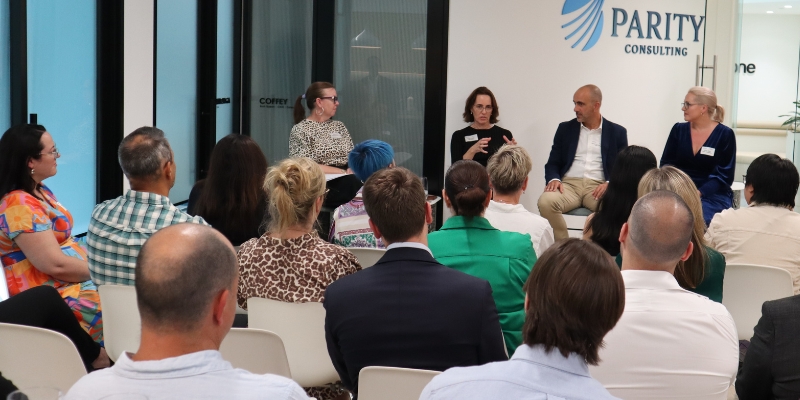
At our recent panel event on winning in the age of generative search, we brought together perspectives from e-commerce, enterprise banking and AI product development to unpack what this shift means in practice.
From reputation-driven visibility and agent-led content production to governance in highly regulated environments, one theme was clear: the brands that stay grounded in real customer problems, while building the right guardrails around AI, will be the ones that lead.
E-commerce and the Early Mover Advantage
To open the conversation, Parity's Vanessa Lalani spoke with Kelly Slessor, founder of Tribe Gen AI and a digital strategist with more than 20 years’ experience across retail, tech and AI. Working with brands from household names to scaling retailers, Kelly sits at the frontline of AI adoption. Her perspective is grounded in e-commerce, a sector moving quickly because it has to, where visibility, conversion and customer experience are directly tied to commercial outcomes.
What’s happening in e-commerce right now, and why is it ahead of the curve in AI?
E-commerce is moving faster because it has to. Revenue is directly tied to digital performance, so experimentation and adoption are commercial necessities.
Unlike many service businesses that lead with their message, e-commerce brands are built around the customer’s problem. That mindset is why they are embracing AI earlier and more effectively.
We are seeing an early mover advantage in generative search, similar to the early days of SEO and social. Brands that invested two years ago are already ranking in AI tools.
How is GEO different from SEO?
SEO ranks pages based on keywords. GEO, generative engine optimisation, is about reputation and problem-solving in context.
AI tools such as ChatGPT, Gemini and Claude synthesise answers, not just links. They respond to real-life scenarios and intent.
Customers do not search for products, they search for solutions. For example, not “superannuation product”, but “best super fund for a 40-year-old with two kids”.
Success in GEO comes from aligning content to genuine customer problems, not just optimising for search terms.
What does optimising for AI answers actually look like?
Structure matters. Websites need to be readable by AI agents. Clear formatting, FAQs and well-labelled sections improve machine interpretation.
Conversational content performs better. Content should answer questions directly and naturally.
Trust signals are critical. AI scans across platforms, including websites, social channels and forums like Reddit, looking for consistency.
Brands cannot rely on website content alone. Reputation across the broader digital ecosystem influences visibility.
What are the three things digital leaders should do now?
Understand customer questions at scale. Use AI tools to identify evolving prompts and trending concerns.
Rework website structure and FAQs to reflect emotional and situational drivers, not just product features.
Build content production capability. AI enables dynamic, scalable content, but it requires guardrails and human oversight.
Kelly emphasised that the brands seeing “hockey stick” growth are those building autonomous agents with embedded tone, regulatory checks and competitive benchmarking.
However, she reinforced that humans must remain in the loop. Poor-quality AI output, or “AI slop”, damages trust and brand equity.

AI in a Highly Regulated Environment
Joe Chapman, Head of AI Products and Analytics at Macquarie Bank, brought a very different lens to the discussion. Operating within one of Australia’s most highly regulated industries, Joe shared a candid view of what it takes to move from AI experimentation to enterprise-wide implementation. His insights focused on governance, accuracy, change management and the practical realities of deploying AI in a customer-facing banking environment.
What is happening with AI at Macquarie, and what are the challenges?
Macquarie has rolled out Gemini Enterprise, enabling all staff to build their own AI agents.
Democratising access has been a core strategy.AI is embedded across internal productivity and customer-facing applications, including “Q”, an AI assistant within mobile banking.
In financial services, accuracy is non-negotiable.
Every incorrect answer can be reportable to regulators.This requires layered oversight, including secondary agents that monitor and validate primary AI responses.
How have you managed people and change internally?
Involving employees in solution design is critical.
Credit analysts and subject matter experts are helping codify nuance that is not documented.Investment in learning and development has been significant, enabling staff to shift from manual processing to higher-order problem solving.
AI is changing skill requirements.
Prompting and business analysis capabilities are increasingly valuable, sometimes more so than traditional data science skills.
What has been the biggest learning and the biggest challenge?
Biggest learning: move beyond AI-generated answers to AI-enabled action.
Real value comes when AI completes tasks within core systems.Biggest challenge: transitioning from proof of concept to regulated, customer-facing deployment.
Governance, compliance and risk frameworks extend timelines significantly.Once foundational systems are in place, iteration becomes faster. Adding capabilities shifts from years to weeks.
Joe reinforced that AI investment should be measured not just in cost savings, but in customer experience improvements, satisfaction and operational resilience.
Measuring and Improving AI Visibility
Rounding out the session, Kevin Morrell, co-founder of Journ3y, shifted the discussion from theory to application. With a background in data science and AI product development, Kevin walked the room through what generative search visibility looks like in practice. Drawing on live audits of participating brands from the audience, he highlighted how AI tools interpret websites, where businesses are falling short, and what can be done to improve discoverability in a rapidly evolving search landscape.
Why did you build this measurement tool?
Journ3y discovered that AI tools were misrepresenting their brand due to misinformation published on obscure websites, combined with technical limitations in how their own site was built. In some cases, AI could not properly read their website at all.
That experience revealed a broader issue: many brands are not optimised for AI visibility, and in some instances, are effectively invisible.
Journ3y's Outrankllm software was built to surface both the strengths and the blind spots in how a website performs in this new AI-driven discovery environment, providing clear insight into how visible, credible and competitive a brand appears when customers turn to generative search.
What the Data Is Showing About AI Discovery
Drawing on insights from hundreds of websites scanned through the tool, several clear patterns are emerging:
50% of scanned websites do not meaningfully show up in AI search.
95% are not in the top three responses, which is critical given AI tools primarily synthesise answers from top-ranked sources.
15% of websites are effectively unreadable by AI due to technical build issues.
B2B brands are averaging significantly lower visibility scores than B2C brands, largely due to differences in content structure, clarity and conversational framing.
Key Takeaways Across the Panel
Generative search is growing quickly and cannot be ignored.
Content clarity, focus and structure are now commercial drivers, not just marketing considerations.
Trust, consistency and reputation across platforms matter more than ever.
AI adoption requires measurement frameworks and clear business cases.
Early experimentation, with guardrails, delivers advantage.
The consistent message from all speakers was simple: start now, stay measured, keep humans involved, and optimise for real customer problems rather than just channels.
If staying ahead of shifts like generative search matters to you and your team, follow Parity on LinkedIn for more grounded insights, market trends and real-world perspectives from across our network. And if you’d like to continue this conversation, connect with Vanessa Lalani here on LinkedIn.
Why Partner with Parity?
We believe exceptional organisations are built on exceptional people.
As an Executive Search, Permanent & Contractor recruitment agency specialising in senior and leadership roles in Product, Digital, Marketing, Transformation and Data across financial services and technology industries, we focus on unearthing talent who add to culture and performance while driving real business growth.
We connect these exceptional candidates with business leaders who need people to not just meet expectations, but exceed them - think of us as expert truffle hunters, uncovering the people who will truly make an impact in your organisation.
Reach out to one of our consultants today.